AI Search Optimization in 2026: A Practical Guide for Businesses

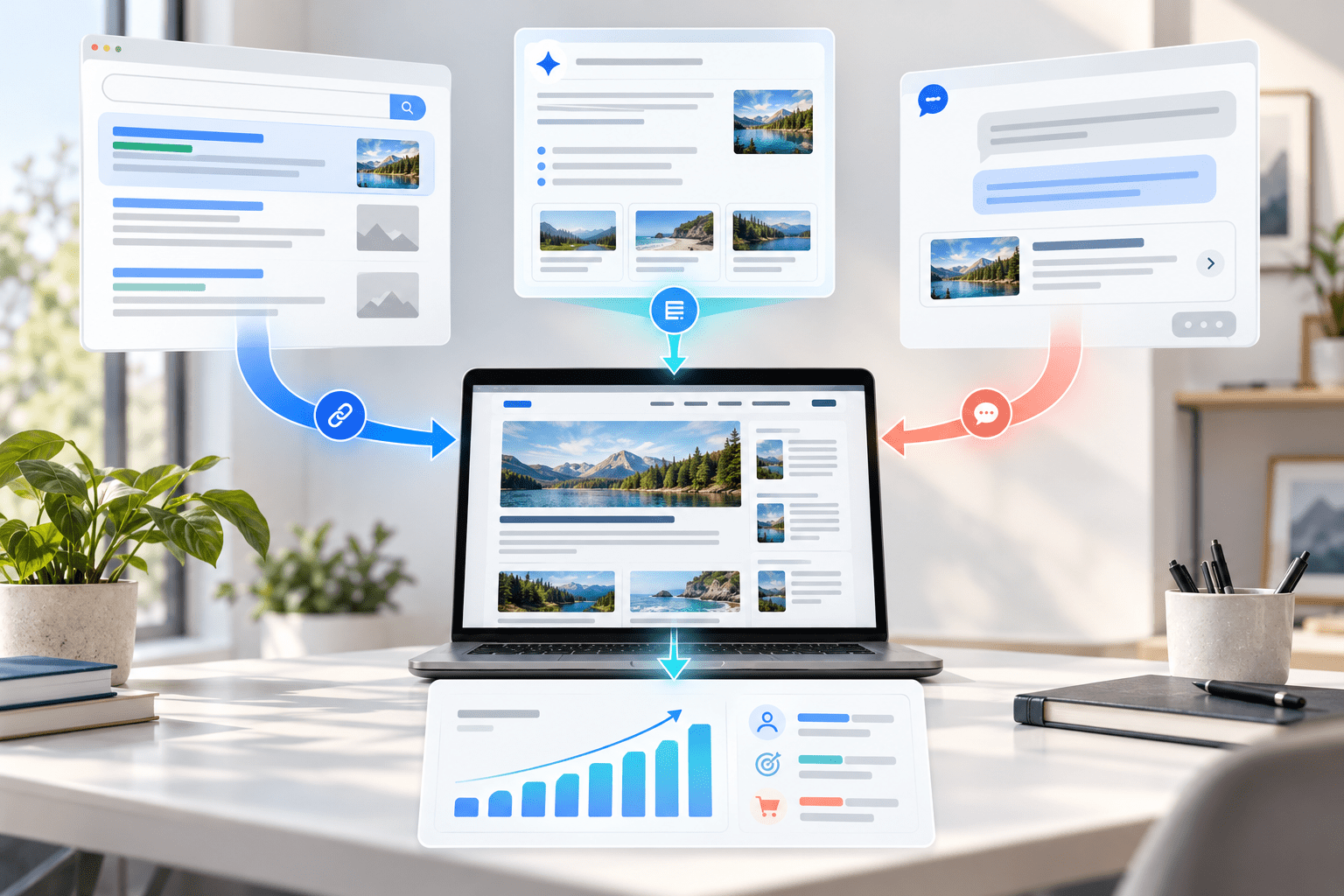
Customers can now discover a product or service through classic Google results, an AI Overview, AI Mode, or ChatGPT. For a business, visibility is no longer limited to holding a familiar blue-link position. Search systems must be able to find the site, understand its information, and judge it useful enough to support an answer.
This guide explains how to prepare a website for AI search without chasing short-lived tricks. It focuses on the technical SEO, expert content, internal linking, and measurement work that businesses can control.
What Changed in AI Search
Google AI Overviews and AI Mode can explore several related subtopics and present supporting links with a generated response. Google’s 2026 guidance says these experiences rely on the same Search index, ranking systems, and quality systems that support classic search. Strong SEO therefore remains the foundation of AI visibility.
Google’s official guide to optimizing for generative AI search also removes some common distractions. Google does not require special AI schema, and an llms.txt file neither helps nor harms visibility in Google Search. Unique content, crawlable pages, a useful experience, and sound measurement matter more.
ChatGPT Search also does not guarantee placement. OpenAI states that OAI-SearchBot must be allowed to access a site if its content is to be eligible for summaries and snippets.
Seven Steps for AI Search Visibility
Make the Site Technically Accessible
Begin with a crawl and index audit. Important pages should return a 200 status, remain accessible through robots.txt, contain indexable primary content, and avoid accidental noindex or nosnippet directives. To appear as a supporting link in Google AI experiences, a page must first be indexed and eligible to show a snippet in regular Search.
For ChatGPT, verify OAI-SearchBot access and confirm that the hosting provider, CDN, or firewall allows OpenAI’s published crawler IP addresses.
Publish Evidence From Real Experience
AI systems have little reason to prefer one generic summary over dozens of similar pages. A business can contribute information that is harder to reproduce: its process, expert commentary, case-study method, pricing logic, recurring customer questions, and measurement approach. Build content around questions that prospects raise in real sales conversations instead of repeating widely available advice.
Label evidence carefully. Give internal data a time period and calculation method. Mark a hypothetical example as hypothetical. Do not turn an observation into a promise.
Answer the Whole Decision
AI search may expand one query into several related searches. A useful page should therefore cover the definition, selection criteria, limitations, implementation steps, and next action when those details belong together. Clear H2 and H3 headings, short definitions, comparison tables, and concrete examples help readers make a decision. Avoid building a thin page for every minor wording variation.
Clarify the Business and the Author
Use consistent business names, locations, contact details, service areas, and areas of expertise. Show a real author and relevant experience on expert articles. For local businesses, an accurate Google Business Profile complements the website and helps connect a service with the correct location.
Use Structured Data in Proportion
Organization, LocalBusiness, Article, Product, or Service markup can support regular search features when it matches visible page content. There is no special AI schema, and markup alone cannot earn a citation. Fix the content and technical issues first, then add only the structured data that accurately describes the page.
Add Useful Images and Video
Relevant images and video create additional discovery opportunities. Prefer real interfaces, processes, products, or expert explanations over generic stock photography. The filename, alt text, and surrounding copy should describe the same subject and help the visitor understand the material.
Build a Logical Internal Link Network
A search system and a visitor should reach an important page through a small number of logical steps. Connect topic articles to the relevant service, case study, and contact page. Use anchor text that describes the destination.
For example, an AI search article can lead to Boost iT’s digital marketing services and the broader social media marketing guide when the reader needs to connect search discovery with a wider acquisition strategy.
What to Avoid
GEO has replaced SEO
What the evidence says: Google continues to ground AI search in its core Search systems
Better action: Improve indexing, useful content, and page experience
llms.txt improves Google visibility
What the evidence says: Google says the file neither helps nor harms its search visibility
Better action: Do not substitute an unproven file for technical SEO
AI search requires special schema
What the evidence says: Google does not require special AI markup
Better action: Use standard structured data only when it matches the page
Publishing many AI articles creates fast growth
What the evidence says: Scaled pages with little added value may violate spam policies
Better action: Publish fewer, expert-reviewed resources with original value
Technical eligibility guarantees a citation
What the evidence says: Neither Google nor OpenAI guarantees inclusion
Better action: Measure visibility and keep improving usefulness
How to Measure the Result
In 2026 Google introduced a dedicated Generative AI performance report in Search Console. It shows which pages appeared in Google’s generative AI features, along with impressions, countries, devices, and changes over time.
Track performance at three levels.
- Visibility Pages and impressions reported for generative AI features.
- Visits Organic and ChatGPT referral sessions, landing pages, and engagement. OpenAI says ChatGPT referral URLs include utm_source=chatgpt.com for analytics tracking.
- Business outcomes Enquiries, calls, purchases, qualified visits, and the page that contributed to each action.
Do not judge the work only by citation counts. The more useful question is which pages became visible, what quality of visit followed, and whether that visit contributed to revenue.
A Practical 30 Day Plan
Week 1
Action: Audit crawling, indexing, robots.txt, sitemaps, canonicals, and OAI-SearchBot access
Output: Prioritized technical issue list
Week 2
Action: Collect real customer questions and compare them with existing pages
Output: Content gap map
Week 3
Action: Upgrade three priority pages with expert evidence, clear structure, and internal links
Output: Publication-ready priority pages
Week 4
Action: Enable Search Console AI reporting, record baseline metrics, and connect conversions
Output: Measurement dashboard and next-test decision
Example for a Local Service Business
Suppose a dental clinic in Yerevan wants visibility for a question such as “how to choose a dental implant type.” A service page alone is unlikely to answer the whole decision. A stronger topic package could include a dentist-reviewed guide, an option comparison, the treatment stages, common questions, the factors that affect price, and a natural link to the consultation page.
Every medical claim should be accurate, identify the reviewer, and cite a reliable medical source when appropriate. This is a hypothetical example, not a performance promise.
Conclusion and Next Step
AI search visibility is not a separate collection of hacks. It starts with an indexable website, clear services, real expertise, and dependable measurement. A business should fix those foundations first, then test new formats and judge them by enquiries and sales.
To understand how prepared your website is for AI search, contact Boost iT. The team can review technical access, content gaps, and measurement, then prioritize the work that supports both search visibility and business outcomes.
Subscribe
Get the latest insights and updates delivered to your inbox.
Want to implement these strategies?
Let's discuss how we can help you achieve similar results.