Hreflang Audit for Armenian and English Websites: A Practical Guide
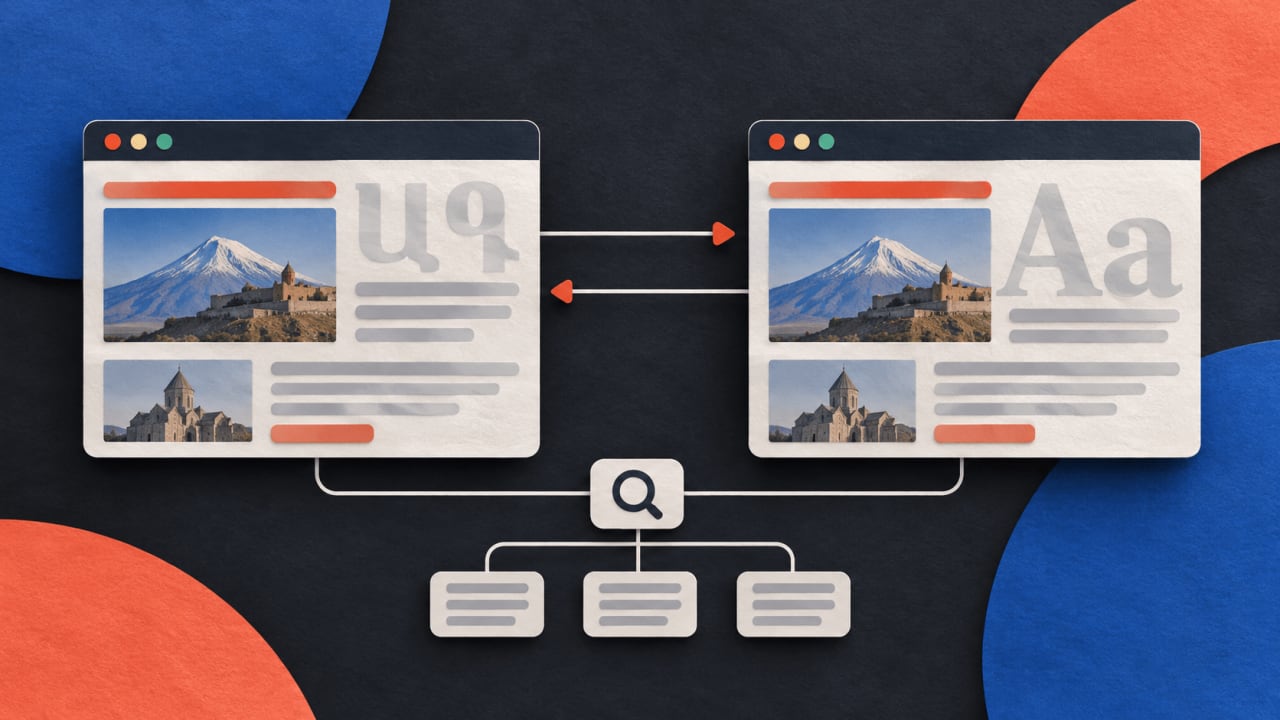
A bilingual site can have excellent Armenian and English content yet still send visitors to the wrong language from search. An hreflang audit checks whether equivalent pages are discoverable, correctly connected and consistent with other indexing signals. Here is a practical way to diagnose the problem before changing a site's templates.
Start with a page-pair inventory
List the Armenian and English URLs for each important service, product and article. Record the intended language, whether the main content is genuinely localized, the HTTP status, indexability, canonical URL and the alternate URLs declared. Pair equivalent pages, not merely pages that happen to share a menu position. If a service has no English equivalent, do not point its Armenian page to an unrelated English homepage as though it were a translation.
For example, a consultancy might pair its Armenian SEO service page with the English page about the same service. Prioritize high-value landing pages first, then scale the checks to templates. Google recommends separate URLs for language versions and notes that automatic language switching can make variants harder to discover.
Check reciprocal hreflang annotations
Google supports HTML head elements, HTTP headers and XML sitemaps as alternative implementation methods. Choose one maintainable method; using all three offers no search benefit and increases the risk of inconsistent sets. Each localized page should list itself and its equivalent alternatives with fully qualified URLs. The links between a pair must be reciprocal. See Google's localized-versions documentation for syntax and supported codes.
For an illustrative two-page set, the Armenian page and its English counterpart each declare the same two alternates: hreflang="hy" pointing to the Armenian URL and hreflang="en" pointing to the English URL. Use the site's real absolute URLs, not placeholders. Language-only codes are appropriate when the pages target those languages broadly; add a valid region code only when there is a genuine regional target. An optional x-default can identify a fallback, such as a language selector, for unmatched users.
Align canonical and indexing signals
Inspect each live page's canonical and the URL Google selected in Search Console. A canonical is a preference, not a guarantee. For hreflang, Google recommends a canonical in the same language, or the best available substitute if there is none. Do not automatically canonicalize a genuinely translated Armenian page to its English counterpart. Review redirects, noindex directives and robots rules too: an alternate pointing to a blocked, redirected or unavailable page needs investigation. Google's canonical guidance explains the signals and their limits.
Test what people and crawlers actually receive
- Open each URL directly in a clean browser session. Confirm the main content, title, navigation and conversion path are usable in the intended language.
- Inspect the delivered HTML head, response headers or sitemap, depending on the implementation. Check absolute URLs, valid codes, self-references and return links.
- Follow the language switcher from each page. It should lead to the equivalent page when one exists, with a clear fallback when it does not.
- Use URL Inspection for representative pages to examine indexing and Google's selected canonical. Compare Search Console performance by page and country over a meaningful period, remembering that rankings and traffic change for many reasons.
- After a template fix, retest a sample of page types and monitor new releases. Record the owner, issue, fix and date so regressions can be found quickly.
Common mistakes to prioritize
- One-way annotations: the English page points to Armenian, but Armenian does not point back.
- Wrong targets: an alternate points to a redirect, missing page or unrelated translation.
- Conflicting signals: a translated page declares the other language as canonical or is unintentionally noindexed.
- Code confusion: a country code alone is not a language-and-region label. Use supported language codes and optional region codes.
- Untranslated content: changing only navigation while leaving the main content in one language does not create a fully localized article.
Turn the audit into a repeatable release check
Start with one representative pair, fix the template or content issue at its source, and then verify other page types. Hreflang helps Google understand relationships; it does not guarantee indexing, rankings or a particular search result. Useful localized content and a working user journey remain essential.
Explore Boost iT's SEO services or contact the team to discuss a multilingual site audit.
Subscribe
Get the latest insights and updates delivered to your inbox.
Want to implement these strategies?
Let's discuss how we can help you achieve similar results.